
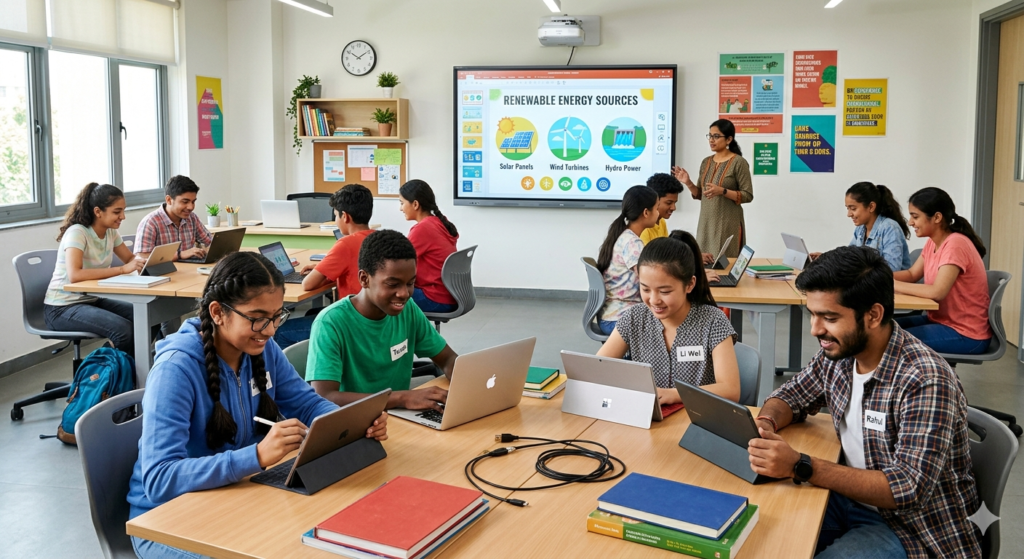
The 21st-century classroom looks nothing like it did just twenty years ago. Interactive whiteboards have replaced chalk-dusted chalkboards. Heavy textbooks are giving way to lightweight tablets. And instead of waiting for a teacher to grade a paper, students can now get instant feedback from an AI tutor. There is no doubt that how technology has changed education is one of the most significant stories of our time. Yet, this transformation is not as simple as swapping analog tools for digital ones. It is a complex story of promise, paradox, and the persistent gap between access and actual learning. While a student in a well-funded district might explore ancient Rome through a virtual reality headset, another in a low-income community struggles to find a stable internet connection for their homework. This article explores the multifaceted impact of technology on teaching, learning, and the very structure of education, offering a clear-eyed view of where we are and where we are headed.
From Chalkboards to Cloud: A Brief Timeline
To understand the present, it helps to look back. The pre-2000s classroom was defined by broadcast learning: the teacher was the expert, and information flowed one way. Overhead projectors and early educational television were novelties, but they didn’t change the core dynamic. The rise of the personal computer in the 1980s and 1990s introduced basic skill-and-drill software, but adoption was slow and uneven.
The real shift began with the internet. By the mid-2000s, resources like Wikipedia and YouTube started democratizing information. The 2010s brought the “device revolution”—iPads and Chromebooks flooded schools, and Learning Management Systems (LMS) like Canvas and Google Classroom became the digital backbone of courses. The pandemic from 2020 to 2022 acted as a massive accelerator, forcing a global experiment in remote learning overnight. Since then, we have entered the age of generative AI. Tools that can write essays, create lesson plans, and tutor students in real-time are no longer science fiction; they are the current reality . This rapid evolution brings us to a critical point in 2026, where the challenge is no longer about getting technology into schools, but about using it wisely.
How Pedagogy Changed with Digital Tools
The presence of technology has fundamentally shifted teaching strategies. It has moved the focus from passive reception to active learning. One of the most significant shifts is the flipped classroom. Instead of lecturing in class and sending students home with problems, teachers now use video to deliver instruction at home, freeing up classroom time for collaborative work and hands-on projects where students can get direct support.
Blended learning models have also become standard. Students cycle through different learning stations, some online and some offline, allowing for a mix of teacher-led instruction and self-paced digital work. This approach makes it easier to implement project-based learning, as students have instant access to research tools, data sets, and collaboration platforms to solve real-world problems. The teacher’s role has evolved from the “sage on the stage” to the “guide on the side,” curating experiences and helping students navigate the overwhelming sea of information now at their fingertips.
What Improved—and What Didn‘t
It’s easy to get swept up in the excitement of new tools, but a balanced view requires looking at both the wins and the losses.
On the improvement side:
- Engagement: Interactive simulations and gamified learning apps can make abstract concepts tangible and motivate students.
- Personalization: Adaptive learning software can adjust the difficulty of problems in real-time based on a student’s performance, offering tailored support that a single teacher in a classroom of thirty cannot always provide.
- Efficiency: Administrative tasks like taking attendance, grading multiple-choice tests, and communicating with parents are now far more streamlined.
However, the drawbacks are significant.
- The Distraction Problem: A recent study published in JAMA Network Open found that middle and high school students spend over two hours of the school day—nearly a third of instructional time—on their smartphones, primarily on social media and entertainment . This constant fragmentation of attention undermines the very cognitive skills needed for learning.
- Surface-Level Use: The OECD Digital Education Outlook 2026 warns that technology is often just a substitute for older methods. Using a PDF worksheet on a tablet is not a transformation. In some cases, reliance on AI tools can backfire; one study cited by the OECD found that while students using AI performed tasks 48% faster, they scored 17% worse when the tool was removed, suggesting they hadn’t actually learned the skill .
Equity and Accessibility: Closing and Widening Gaps
For years, the “digital divide” was about hardware: who has a computer and who doesn’t. While that gap persists—especially in low-income communities where only about 15% have stable internet access —a new, more subtle divide has emerged. Experts now talk about the “second-level digital divide” and even an “AI divide” . This isn’t just about access; it’s about effective use.
Students in well-resourced schools are often guided to use technology for creation, coding, and critical analysis. In contrast, students in under-resourced schools may use technology primarily for drill-and-practice or remedial work. This disparity in how technology is used threatens to widen achievement gaps.
On a positive note, technology has been a game-changer for accessibility. Assistive technologies like screen readers, speech-to-text software, and communication devices for non-verbal students have opened doors for learners with disabilities. Furthermore, the ability to translate content instantly means a classroom can support students from diverse linguistic backgrounds. For our readers interested in technology meaning in hindi, the word is “प्रौद्योगिकी” (Pradyogiki), and modern platforms are increasingly able to deliver content in regional languages, making education more inclusive across India and the world.
Assessment in a Digital Age: Integrity, Feedback, and Data
Remember bubbling in answer sheets with a #2 pencil? That process is rapidly disappearing. Digital assessment tools allow for much more than multiple-choice questions. Students can create videos, record podcasts, or build websites to demonstrate their understanding. Formative assessment—quick, low-stakes checks for understanding—has become easier with tools that provide instant feedback, allowing teachers to adjust their lessons on the fly.
However, the rise of generative AI has thrown academic integrity into crisis. If an AI can write an essay in seconds, how do teachers assess a student’s authentic writing ability? This has sparked a shift in assignment design. Many educators are moving away from take-home essays toward more in-class, process-oriented writing, or asking students to reflect on and critique AI-generated text. Organizations like the ETS Research Institute are launching dedicated centers to ensure AI is used responsibly in assessment, focusing on fairness and validity . The goal is to measure what students truly know, not just what they can copy.
Teachers‘ Work Reimagined: Planning, Feedback, and PD
Perhaps the most profound, yet often invisible, impact of technology is on teacher workflow. A 2024 survey found that around 37% of teachers already use generative AI for work-related tasks . Planning a lesson, which used to take an hour, can now take ten minutes with AI-generated ideas and resources. In England, secondary science teachers using AI tools reduced their lesson preparation time by 31% . This is not about replacing teachers; it’s about giving them back their most precious resource: time.
Professional development (PD) has also been transformed. Teachers no longer have to wait for a district-wide workshop day. They can join global Twitter chats, watch on-demand webinars, or access curated resource libraries online. However, this shift also requires that teacher preparation programs evolve. New educators need training not just on how to use technology, but on how to integrate data and computing concepts into their teaching effectively .
Case Studies: Three Snapshots That Show Impact
1. K–12: The Renaissance Intelligence System (2026)
In early 2026, Renaissance launched a new “Education Intelligence System” designed to unify assessment, instruction, and practice. By integrating previously siloed data, the platform provides teachers with AI-generated recommendations for student grouping and targeted interventions. Early results suggest that this coherence—moving away from disconnected apps—helps teachers make faster, data-informed decisions, potentially accelerating learning at scale .
2. Higher Ed: Community Colleges and the AI Divide
Community colleges, which serve a disproportionate number of first-generation and low-income students, are on the front lines of the new AI divide. According to recent research, while AI offers potential for personalized support, it also risks exacerbating inequities if students from underserved backgrounds lack access to reliable devices or the skills to use AI tools effectively. Institutions are now developing equity-focused strategies to ensure AI serves as a “bridge, not a barrier,” including integrating AI literacy into orientation and student support services .
3. Workforce & Continuing Ed: Jaipur’s EnCODE Platform (2026)
At the AI Impact Summit 2026 in New Delhi, Jaipur-based CODE Edu launched “EnCODE,” an AI-powered creative learning platform. This initiative recognizes that the future workforce needs skills at the intersection of technology and creativity. By offering courses in design, animation, and VFX, and partnering with industry giants like Adobe, the platform aims to build a “future-ready creative workforce” for India’s “Orange Economy,” showing how technology can bridge the gap between higher education and employment .
Student Motivation and Well-Being
This brings us to a fundamental question: can technology give us happiness in the context of learning? The answer is complicated. A well-designed learning app can provide a dopamine hit of accomplishment when a student levels up or masters a tough concept. This can boost confidence and motivation. However, the happiness derived from learning is often deep and intrinsic—the “aha!” moment of understanding—while the happiness from technology is often shallow and fleeting.
The research on smartphone use in schools paints a worrying picture of well-being . Constant notifications and the pull of social media create a state of continuous partial attention, which can lead to anxiety and reduce the ability to focus deeply. The happiest and most motivated students are often those in environments where technology is used intentionally as a tool for creation and connection, not as a constant source of entertainment. The goal for educators is to design experiences that leverage technology to foster the deep satisfaction of mastery, not just the shallow thrill of distraction.
Privacy, Safety, and Ethics by Design
As schools collect more data than ever before—on student attendance, grades, behavior, and even which parts of an online textbook they read—privacy concerns have moved to center stage. The student data ecosystem is complex, with information often flowing through third-party vendors, apps, and cloud platforms. A recent Stanford paper highlights how much of this data falls into a “regulatory gray zone,” requiring a stronger federal framework for transparency and accountability .
Furthermore, the algorithms powering many AI tools are not neutral. They can reflect the biases of their creators, potentially leading to unfair outcomes for students from certain racial or socioeconomic backgrounds . An “ethics by design” approach means building safeguards into technology from the ground up, ensuring that it supports all students fairly. For educators and parents, this means asking tough questions: Where is this data going? How is it being used? And who is it helping or hurting?
What‘s Next: 2026–2030 Trends to Watch
Looking toward the end of the decade, several trends will shape the next chapter of this story.
- AI Literacy as a Core Subject: Just as reading and math are fundamental, understanding how AI works, its limitations, and its ethical implications will become a standard part of the K-12 curriculum .
- The Rise of Micro-Credentials and Competency-Based Education: The traditional diploma may be supplemented by digital credentials that verify specific skills. This allows learners to demonstrate competencies gained not just in a classroom, but through work and life experience, creating more flexible and personalized pathways .
- Immersive Learning (AR/VR) Goes Mainstream: As hardware becomes cheaper and content more sophisticated, augmented and virtual reality will move from novelty to standard practice, allowing students to conduct virtual science experiments or “visit” historical sites with ease .
- From Tech Adoption to System Redesign: The OECD argues that the real challenge is not adopting technology, but redesigning education systems—curriculum, assessment, teacher training, and governance—around it. Isolated tools won’t work; systemic alignment will .
Key Takeaways
- Access is not enough: Providing devices and internet is just the first step. The real challenge is ensuring all students use technology for creation and critical thinking, not just passive consumption.
- AI is a double-edged sword: It can personalize learning and reduce teacher workload, but it also risks widening equity gaps, enabling cheating, and distracting from deep understanding if not used carefully.
- Teacher support is critical: Technology’s success depends on the teacher. Effective professional development and tools that reduce administrative burdens are essential for meaningful change.
- Ethics must be proactive: Data privacy and algorithmic fairness cannot be afterthoughts. Schools and vendors must prioritize “ethics by design” to protect students and build trust.
- The goal is transformation, not substitution: Using a tablet to do the same old worksheet is not progress. True transformation happens when technology enables entirely new ways of teaching, learning, and thinking.
Conclusion: What Matters Most
As we have seen, how technology has changed education is not a story with a simple happy or sad ending. It is a story of incredible potential tempered by persistent challenges. Technology has broken down the four walls of the classroom, connecting students to the world and giving them tools that were unimaginable a generation ago. It has empowered teachers and opened doors for learners with disabilities. Yet, it has also introduced new avenues for distraction, new forms of inequality, and complex ethical dilemmas.
Ultimately, the technology itself is neutral. It is a mirror reflecting our priorities as a society. Will we use it to create more equitable, engaging, and human-centered learning experiences? Or will we allow it to amplify existing problems and leave students more disconnected than ever? The answer lies not in the code, but in the choices made by educators, policymakers, and communities. The future of education will be shaped less by the next killer app and more by our collective wisdom in wielding the powerful tools we already have.
1. Can technology give us happiness in learning?
It can, but it depends on how it’s used. The immediate gratification from a gamified app can provide a short-term motivational boost. However, lasting happiness in education usually comes from the deeper satisfaction of mastering a difficult skill or understanding a complex idea. Technology is most effective when it facilitates these “aha!” moments rather than just providing shallow entertainment.
2. Who created technology?
Technology isn’t something a single person created. It’s a cumulative human achievement. It began with the first stone tools made by our earliest ancestors. Every generation builds upon the discoveries of the previous one. In the context of education, “technology” ranges from the invention of the book to the development of the internet, with countless innovators contributing along the way.
3. What does “technology” mean in Hindi?
The Hindi word for technology is “प्रौद्योगिकी” (pronounced Pradyogiki). It refers to the application of scientific knowledge for practical purposes. As digital education expands in India, platforms are increasingly incorporating multilingual support, making learning accessible to students in their native languages.
4. How can schools keep up with technology news without chasing fads?
Schools should focus on pedagogy first, technology second. Instead of chasing every new app, they should start with a clear educational goal (e.g., improving writing skills, fostering collaboration) and then look for proven tools that serve that goal. Reading independent research from organizations like the OECD or attending educator-focused conferences can help filter the signal from the noise.
5. What is a technology park and does it matter for education?
A technology park (or research park) is a geographic area that clusters together tech companies, university research labs, and startup incubators. They matter for education because they create a pipeline for innovation. Universities near tech parks, like Stanford in Silicon Valley, often have strong partnerships with industry, leading to cutting-edge research, internship opportunities for students, and the commercialization of new educational tools.
References
: Think Academy. (2025, August 31). 2030 Education Landscape: How AI and Globalization Are Transforming the Future Classroom. [Lin
: National Academies of Sciences, Engineering, and Medicine. (2026, March 11). *Integrating Data and Computing into K-12 Education Is Critical and Requires Coordinated Approach To Be Effective, Says New Report*. [Link]
: Worlddidac. (2026, January 26). OECD Digital Education Outlook 2026: When Technology Does Not Equal Transformation. (Summary of OECD findings). [Link]
: Siddiqi, M. (2026). New Digital Divide in the Age of AI: Equity and Access in Higher Education. Wiley Online Library. [Link]
: ETS. (2026, January 20). ETS Research Institute Launches Center for Responsible AI in Learning and Assessment. [Link]
: Renaissance. (2026, February 19). Renaissance Launches First-Of-Its-Kind Education Intelligence System That Redefines Personalized Teaching and Learning. [Link]
: Thompson, D. / HealthDay. (2026, March 10). Students Spend A Third Of Their School Day On Their Smartphone, Study Says. U.S. News & World Report. [Link]
: Langevine, S. L. (2026). Protecting Student Data in the Age of AI: A Federal Framework for Transparency, Accountability, and Auditability. Stanford University. [Link]