
What Digital Marketing Means
If you’ve ever searched Google for a plumber, clicked a Facebook ad for sneakers, or opened a promotional email from your favorite coffee shop, you’ve experienced digital marketing in action. At its core, what digital marketing means is simple: using online channels to connect with current and potential customers.
But it’s more than just “being on social media.” Digital marketing encompasses every touchpoint where businesses and customers interact digitally.Why Digital Marketing Is Important for Business in 2026 That includes your website, search engine results, email inboxes, social platforms, mobile apps, and even text messages.
The beauty of digital marketing lies in its precision. A billboard on the highway shouts at everyone who drives past. A well-targeted Instagram ad, by contrast, whispers directly to someone who recently searched for yoga classes in their neighborhood. That shift—from broadcasting to conversing—changes everything about how businesses grow.
Owned, Earned, and Paid: How They Work Together
Marketing professionals often break digital channels into three categories. Understanding this framework helps demystify how the pieces fit together.
Owned media is exactly what it sounds like: channels you control completely. Your website, your blog, your email list, and your mobile app all belong here. These are your digital storefronts—the places where you set the rules and build direct relationships without intermediaries.
Paid media includes anything you pay for to reach an audience. Google Ads, social media advertising, sponsored content, and display banners fall into this bucket. Think of paid media as the megaphone that amplifies your message to people who haven’t found you yet.
Earned media is the digital equivalent of word-of-mouth. When customers share your content, leave positive reviews, mention you on social platforms, or journalists write about your business, that’s earned media. You can’t buy it directly—you have to earn it through remarkable products, services, or content.
The magic happens when these three work together. A paid ad introduces someone to your brand. They visit your website (owned) and sign up for your newsletter. Six months later, they love your product so much they post about it on LinkedIn (earned). That post drives new visitors, and the cycle continues.
From Search to Social to Email: The Integrated Funnel
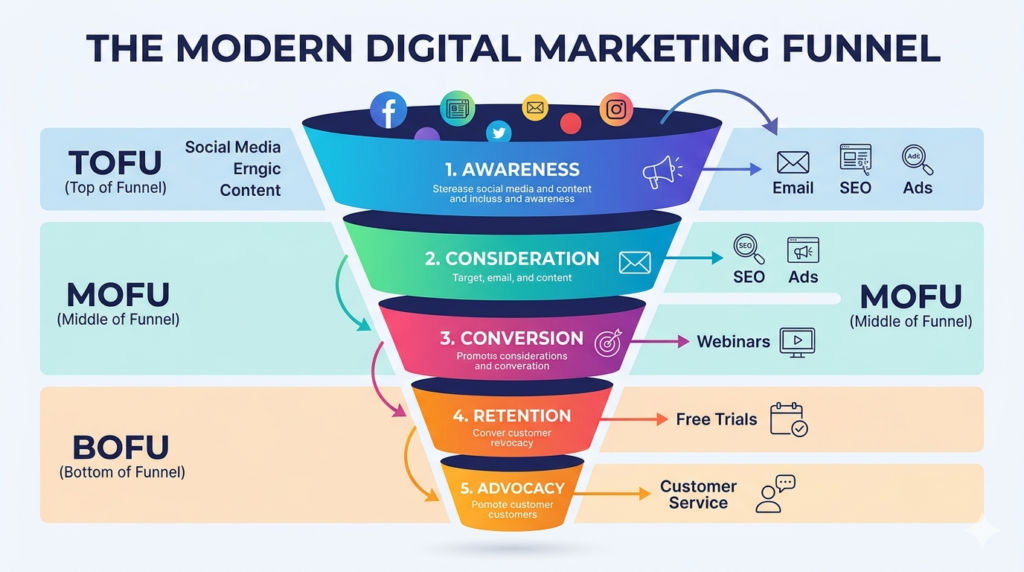
Think of customer relationships as a journey rather than a single transaction. Digital marketing provides tools for every step.
At the top of the funnel, someone has a problem. They type “best running shoes for marathon training” into Google. If your SEO strategy is solid, they find your blog post comparing top marathon shoes. They read, they learn, and now they know you exist.
A week later, they see your retargeting ad on Instagram featuring those same shoes. They click through to your site, browse, but don’t buy. A few days later, an email pops into their inbox offering 10% off their first purchase if they sign up for your newsletter. They subscribe, get the discount, and finally make the purchase.
Three months later, you send them training tips via email. They feel supported, so they buy another pair for their spouse. When their friends ask where they got their shoes, they send them your way.
This is the integrated funnel in action. Search builds awareness. Social nurtures consideration. Email converts and retains. Each channel feeds the next, creating a system that works better than any single tactic alone.
The Business Case: How Digital Marketing Drives Growth
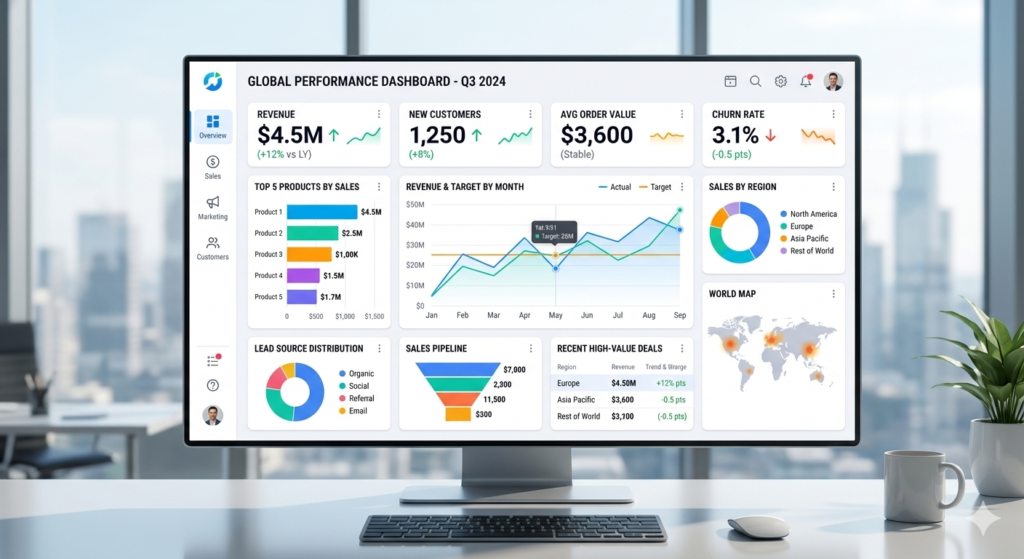
Digital marketing matters because it solves the fundamental problem every business faces: connecting with the right people at the right time with the right message. Here’s how it actually drives growth.
Lower Customer Acquisition Cost with Better Targeting
Traditional advertising operates on a spray-and-pray model. You buy a newspaper ad or a radio spot, cross your fingers, and hope some of the people seeing it might need what you sell. You pay the same rate whether they’re interested or not.
Digital marketing flips this model. Instead of paying for reach, you pay for relevance. A Facebook ad campaign can show your message only to women aged 25–40 within 10 miles of your store who have expressed interest in natural skincare. You’re not wasting money on people who will never buy.
The math is straightforward. If you spend $1,000 on a local newspaper ad and reach 10,000 people, your cost per thousand impressions is $100. But if only 100 of those people might actually need your service, you’re effectively paying $10 per relevant prospect. A digital campaign targeting exactly those 100 people might cost $200 total—but you reach all of them, and your cost per relevant prospect drops to $2.
This efficiency compounds over time. As you collect data on what works, your targeting gets sharper and your costs drop further.
Measurability and Attribution: Spend Where ROI Is Highest
Perhaps the most frustrating aspect of traditional marketing is the mystery. You run an ad, sales go up, but you can’t prove the ad caused it. Maybe it was the weather. Maybe a competitor closed. Maybe it was just a good month.
Digital marketing eliminates the guesswork. You can see exactly how many people saw your ad, how many clicked, how many bought, and exactly how much revenue each campaign generated. Every dollar has a digital footprint.
This measurability enables something revolutionary for small and medium businesses: confidence in your spending decisions. When you know that email marketing generates $42 for every $1 spent, while display ads generate $3 for every $1 spent, you know exactly where to put your next marketing dollar.
Attribution tools even help you understand complex customer journeys. Maybe the last click before purchase came from a Google ad, but you can trace the customer’s first interaction back to a blog post six months ago. That understanding helps you give proper credit to every channel that contributed to the sale.
Speed of Experimentation: Test–Learn–Scale Loops
In the old days, testing a new marketing approach meant committing to a 13-week print campaign or a six-month billboard contract. If it failed, you were out significant money and time.
Digital marketing runs at internet speed. You can launch a Facebook ad campaign this morning, analyze the results by lunch, and adjust your targeting this afternoon. By tomorrow, you’re running a refined version. By next week, you’ve tested five different approaches and identified the winner.
This speed creates a powerful advantage. Businesses that embrace experimentation learn faster than competitors who stick with what’s always worked. They discover new customer segments, new messaging angles, and new channels before their competitors even start looking.
The loop is simple: test something small, measure the results, learn what worked, scale the winners. Repeat constantly. Over months and years, these small improvements compound into massive competitive advantages.
Channels That Matter and When to Use Them
Not every channel makes sense for every business. Here’s what you need to know about the major players and where they fit.
SEO and Content for Compounding Growth
Search engine optimization (SEO) and content marketing are the tortoises of digital marketing. They’re slow to build but provide lasting value.
When you publish a helpful blog post or optimize your website for relevant searches, you’re creating an asset that can attract visitors for years. Unlike paid ads that stop working the moment you stop paying, good content keeps working while you sleep.
SEO works best for businesses whose customers actively search for solutions. A roofing company, a financial advisor, or a B2B software provider should prioritize SEO because their customers are already searching for their services. For these businesses, ranking on page one of Google is like having a 24/7 sales team.
PPC for Predictable, On-Demand Traffic
Pay-per-click advertising, particularly Google Ads, offers something SEO can’t: immediacy. You can launch a campaign today and have traffic flowing within hours.
PPC shines when you need predictable, scalable traffic. A wedding photographer heading into peak season might increase Google Ads spending to capture last-minute planners. A retailer launching a new product might use shopping ads to get immediate visibility.
The trade-off is obvious: you pay for every visitor. But when you’ve done your math correctly—knowing your conversion rate and customer value—paid traffic becomes a reliable customer acquisition machine rather than an expense.
Social and Community for Trust and Advocacy
Social media rarely drives direct sales for most businesses. Someone scrolling Instagram at 9 p.m. isn’t usually in buying mode. But social platforms build something equally valuable: trust.
When potential customers see you showing up consistently, responding to comments, and sharing useful content, they develop a sense of connection. By the time they’re ready to buy, you’re not a stranger—you’re the business they’ve been following for months.
Community-focused platforms like LinkedIn for B2B or Instagram for visual brands create spaces where customers advocate for you. When a satisfied client tags you in their post, their network sees it as a trusted recommendation. That social proof is impossible to buy and incredibly valuable.
Email, SMS, and CRM for Retention and LTV
Here’s a truth many businesses overlook: your existing customers are your most valuable marketing channel. They’ve already bought from you. They trust you. They’re far more likely to buy again than a cold prospect is to buy for the first time.
Email marketing and SMS campaigns exist to nurture these relationships. A thoughtful email sequence can turn a one-time buyer into a loyal customer who purchases repeatedly. Abandoned cart emails recover sales that would otherwise be lost. Birthday discounts create goodwill and incremental revenue.
Customer relationship management (CRM) systems tie all this together. They track interactions, segment audiences based on behavior, and ensure you’re sending the right message to the right person at the right time. This infrastructure turns reactive marketing into proactive relationship-building.
Getting Started: Practical Steps for Any Business
You don’t need a massive budget or a full marketing team to begin. Here’s how to start building your digital marketing foundation.
Set Goals and KPIs
Before you do anything, decide what success looks like. More website traffic? More phone calls? More online sales? More newsletter subscribers? Each goal points toward different channels and metrics.
Write these down. Share them with anyone involved in your marketing. Return to them every month to track progress. Goals without measurement are just wishes.
Map Your Customer Journey and Content
Take out a piece of paper (or open a doc) and map the journey your ideal customer takes from problem to purchase. What triggers their search? What questions do they have along the way? What hesitations might they feel before buying?
For each stage of this journey, identify what content or information would help them move forward. At the awareness stage, they need educational content. At consideration, they need comparisons and proof. At decision, they need confidence and perhaps an incentive.
This simple exercise reveals exactly what you need to create and where to put it. You’re not guessing what customers want—you’re building exactly what they’re already looking for.
Budgeting and Resource Mix
You have three options for executing your digital marketing: in-house hires, freelancers, or agencies. Each has trade-offs.
In-house gives you dedicated attention and deep institutional knowledge but requires salary commitments and benefits. Freelancers offer flexibility and specialized skills for specific projects but require good management. Agencies provide full-service capabilities and strategic guidance but at a higher monthly cost.
For most small businesses starting out, a hybrid approach works well. Hire a part-time marketing coordinator to manage day-to-day activities and coordinate with specialized freelancers for SEO, content, or paid ads. As revenue grows, you can bring more capabilities in-house.
FAQs and Related Topics
What about digital marketing if my audience is local?
Local businesses have some of the best opportunities in digital marketing. Google Business Profile optimization ensures you show up when nearby customers search. Local SEO helps you rank for “near me” searches. Hyper-targeted social ads can reach people within a specific radius of your location.
A local restaurant might use Instagram to showcase daily specials to people within five miles. A plumbing company might run Google Ads targeting only their service area during business hours. Digital marketing works exceptionally well for local businesses because you can be incredibly precise about who sees your message.
What digital marketing course should I take first?
If you’re just starting to learn, focus on fundamentals rather than platforms. A course that covers marketing strategy, customer psychology, and measurement frameworks will serve you better than one teaching only Facebook Ads tactics. Platforms change constantly; principles endure.
Google’s Digital Garage and HubSpot Academy offer excellent free foundational courses. Once you understand the basics, specialized courses in SEO, content marketing, or paid advertising make sense based on your specific needs.
What digital marketing means in simple terms
At its simplest, digital marketing means using the internet to tell people about your business and convince them to buy from you. But more than that, it means using data to understand what those people actually want, so you can stop guessing and start serving.
Is digital marketing a good career? Skills and roles
Absolutely. The demand for digital marketing talent far exceeds supply, and the field offers tremendous variety. You might specialize in SEO, become a content strategist, manage paid advertising campaigns, analyze marketing data, or lead social media for major brands.
Common jobs for digital marketing professionals include SEO specialist, content marketing manager, social media strategist, email marketing coordinator, PPC analyst, and marketing director. Salaries range from entry-level positions around $45,000 to senior roles exceeding $150,000. The field rewards continuous learning and adaptability.
Digital marketing services: what to look for in a provider
If you’re considering hiring a digital marketing service, look for transparency above all. Good agencies share exactly what they’re doing, report clearly on results, and educate you rather than keeping you in the dark. Avoid providers who promise guaranteed rankings or overnight results—digital marketing doesn’t work that way.
Ask potential partners about their experience with businesses like yours, request case studies with actual numbers, and ensure they’re focused on metrics that matter to your bottom line, not vanity metrics like likes and followers.
Case Snapshots
B2C Example: DTC brand reduces CAC by 28% with SEO + email
A direct-to-consumer supplement brand relied entirely on Facebook ads for customer acquisition. As advertising costs rose, their customer acquisition cost climbed unsustainably. They invested in SEO content addressing common health questions and built an email list from site visitors.
Within nine months, organic search traffic grew to 35% of total visitors. Email marketing to engaged subscribers generated 22% of revenue. Combined, these channels reduced their overall customer acquisition cost by 28% while diversifying their traffic sources.
B2B Example: SaaS lifts pipeline 35% via content + retargeting
A B2B software company selling to HR professionals struggled with long sales cycles. Prospects would visit the site, download a whitepaper, then disappear for months. They implemented a content strategy targeting specific HR pain points and built retargeting campaigns to stay visible.
When prospects returned to research solutions, they saw consistent messaging across LinkedIn, display ads, and email nurturing sequences. The company increased marketing-generated pipeline by 35% within two quarters while reducing cost per lead by 18%.
Common Pitfalls and How to Avoid Them
Jumping on every new platform. When a new social network emerges, there’s pressure to join immediately. Resist it. Wait until you see evidence that your actual customers are there, not just early adopters and competitors.
Prioritizing vanity metrics. Thousands of social media followers mean nothing if those followers never buy. Focus on metrics tied to business outcomes: leads, sales, customer lifetime value.
Neglecting mobile users. Over 60% of web traffic comes from mobile devices. If your website isn’t optimized for phones, you’re frustrating the majority of your visitors before they even see your content.
Inconsistent effort. Digital marketing rewards consistency. Posting on social media for three weeks then disappearing for two months destroys momentum. Choose a sustainable pace and stick to it.
Trying to do everything. One channel done well beats five channels done poorly. Master one before adding another.
Conclusion and Next Steps
Digital marketing matters because your customers live online. They search there, they socialize there, and they make buying decisions there. Meeting them where they already are isn’t just smart—it’s essential.
The good news? You don’t need to master everything at once. Start with one channel where your customers spend time. Create content that genuinely helps them. Measure what happens. Learn from the results. Then do more of what works.
Whether you’re a local bakery wanting more foot traffic or a B2B consultancy seeking enterprise clients, the principles are the same. Know your customer. Show up where they are. Provide value. Build relationships. The tools change, but these fundamentals endure.
Ready to put this into practice? Download our free Digital Marketing Starter Kit with worksheets for mapping your customer journey, setting your first KPIs, and choosing your priority channels. [Get the starter kit here]
On-Page SEO Pack
Title Tag (60 characters)
Why Digital Marketing Is Important for Business in 2026 | Growth Guide
Meta Description (158 characters)
Discover why digital marketing is important for business growth in 2026. Learn practical strategies to attract customers, increase sales, and build your brand online.
URL Slug
why-digital-marketing-is-important-for-business
Open Graph Title
Why Digital Marketing Is Important for Business in 2026: Complete Guide
Open Graph Description
Digital marketing drives measurable growth. This guide explains why it matters for your business and how to start getting results today.
Target Keywords Used
| Keyword | Location |
|---|---|
| why digital marketing is important for business | H1, intro, H2, image alt text |
| is digital marketing a good career | H3 under FAQs |
| what digital marketing course | H3 under FAQs |
| what digital marketing means | H3 under FAQs, paragraph 2 |
| digital & marketing | Used naturally in “the relationship between digital & marketing” (introductory section) |
| digital marketing course | H3 under FAQs |
| what about digital marketing | H2 subhead under FAQs |
| job for digital marketing | Normalized to “jobs for digital marketing” in FAQs |
| digital marketing service | H3 under FAQs |
| digital marketing services | H3 under FAQs |
Schema Markup
json
{
  "@context": "https://schema.org",
  "@type": "BlogPosting",
  "headline": "Why Digital Marketing Is Important for Business in 2026",
  "description": "Comprehensive guide explaining why digital marketing drives business growth, with practical steps for getting started across key channels.",
  "image": "https://yoursite.com/images/digital-marketing-funnel.jpg",
  "author": {
    "@type": "Organization",
    "name": "Your Brand Name",
    "url": "https://yoursite.com"
  },
  "publisher": {
    "@type": "Organization",
    "name": "Your Brand Name",
    "logo": {
      "@type": "ImageObject",
      "url": "https://yoursite.com/logo.png"
    }
  },
  "datePublished": "2026-03-15",
  "dateModified": "2026-03-15",
  "mainEntityOfPage": {
    "@type": "WebPage",
    "@id": "https://yoursite.com/blog/why-digital-marketing-is-important-for-business"
  },
  "keywords": "digital marketing, business growth, SEO, social media marketing, email marketing, PPC advertising"
}
Suggested Internal Links
| Anchor Text | Target Topic |
|---|---|
| content marketing strategy | Blog post on developing content that converts |
| SEO services pricing | Service page outlining SEO packages |
| email marketing best practices | Guide to building and nurturing email lists |
| social media advertising tips | Article on paid social strategies |
| customer acquisition cost explained | Deep dive into CAC calculation and reduction |
Suggested External Sources
| Source | Domain | Use Case |
|---|---|---|
| Google Digital Garage | learn.withgoogle.com | Reference for free digital marketing courses |
| HubSpot Academy | academy.hubspot.com | Citation for marketing statistics and frameworks |
| Statista | statista.com | Source for mobile traffic and digital behavior data |